Showing posts with label Profile. Show all posts

Saturday, 23 July 2011

The Bengal Tigress

Mamata Banerjee
“I entirely believe that this is a victory of democracy. This is a victory of 'Ma, Mati, Manush'. This is a victory against years of oppression, exploitation and extortion. This is a victory of helpless people, of the hills, forests, and my 'Ma Mati Manush'.” said Mamata Banerjee, to a huge gathering of supporters outside her house, in a historic speech on the day of counting of the votes, even before the results of the Trinamool Congress’s victory were officially declared.
Clad in a simple white sari, her ‘trademark’, this firebrand orator emerged as the unchallenged victor of the West Bengal Assembly elections of 2011, in which the Trinamool Congress(TMC) almost completely routed the Left in the state, with only four out of the twenty-eight ministers being elected into the assembly, thereby effectively ending a 34 year old dictatorial rule of the Left in the state and provided the state with it’s first: a woman chief Minister.
A woman of simple means, ‘Didi’, was born on 5th January 1995, to Promileshwar Banerjee, a Congress worker and Gayetri. This woman leader who emerged time and again as the defender of the weak had been a particularly vociferous opposition in her crusade against the Left government’s forceful land acquisition for Special Economic Zones.
She started her career as a Congress (I) worker in 1970 while studying for a degree in Law from the Calcutta university. She quickly rose in rank and was soon appointed as the General-Secretary of the Mahila Congress (I) of West Bengal. First noticed when she threw herself before Jayprakash Narayan’s in 1975 convoy, Mamata hasn’t looked back since.
Banerjee’s real break in mainstream Indian politics came in 1984, when she defeated Left heavyweight Somnath Chatterjee from the Jadhavpur constituency, thereby emerging as one of the youngest parliamentarians of all time. She then went on to become the General Secretary of the All India Youth Congress.
Didi suffered a setback in 1989 when the anti-incumbency wave against the Congress after the Bofors scandal rocked the nation that cost her seat, but she came back with a vengeance in 1991, when she was elected from the Calcutta South constituency. She has retained the seat since then, in the 1996, 1998,1999 2004 and the 2009 Lok Sabha elections.
In 1996, Banerjee accused the Congress of being at the mercy of the Left. As her differences with the Congress (I) grew, she finally broke away from the Congress and formed the Trinamool Congress, which became the primary opposition to the Left Front government. She joined the National democratic Alliance in 1999, where she was given the railway portfolio.
Differences between the Trinamool Congress and the other partners of the NDA, forced her to leave the alliance. However, she came back to the alliance in January 2004, where she was given the coal ministry until the 2004 general election.
It was the forceful land acquisitions by the left front for a chemical hub in special economic zones in Nandigram and the ruthless police crackdown on the protesting farmers that really brought the TMC to the front page. With her vehement campaign the acquisition and her protests against the brutal police action, she rose in the popularity charts in West Bengal.
It seemed Banerjee had endeared herself to lady luck, for, then on, this lady could do no wrong. First came the Panchayat elections, in which the TMC won two Zilla Parishads. Next, she made headlines when she successfully drove the Tatas out of Singur. Then came the 2009 general elections, where 19 candidates of the TMC got elected to the Lok Sabha. Then came another victory for Mamata, with the Trinamool Congress gaining a landslide victory at the Kolkata Municipal elections . And finally, the sweetest victory of them all was the 2011 assembly polls, in which the TMC formed a pre-poll alliance with the Congress(I) , bringing a landslide win for the Banerjee and sent the Left front packing after a long, unbroken reign of 34 years.
The ‘iron lady’ has achieved many feats since. The Assembly passed the Singur land Rehabilitation and Development bill, 2011 which ensures that ‘unwilling’ farmers get back the land acquired in the Tata Nano project, with an unbelievable haste. Next, within a month of assuming the office of the chief minister, she declared that long-standing Gorkhaland issue and signed an agreement with the Gorkha Janmukhti morcha (GJM), whence more autonomy will be given to the hill council of Darjeeling.
However, Mamata’s political journey was far from being a bed of roses. Her split with the NDA over the Eastern Railway issue portended the beginning of a long spell of bad luck for the TMC. First they lost the assembly elections of 2002. Then came the 2004 general elections where she emerged the only Trinamool leader to win a seat from West Bengal. Thereafter, came the Kolkata Municipal elections of 2004, where the party Lost control of the Kolkata Municipal Corporation. She has also, in the past, courted several controversies, and she has been accused of being soft on the Maoists, even to the extent of supporting them.
From her Mahila Congress days to the President of the Trinamool Congress, is an important ally at the centre, Banerjee has come a long way. Despite her success, Didi has been known for her simple living. “I am a simple man” she once said proudly. She still lives in her modest lower middle class home at Kalighat.
While praising Mamata, Partha Chaterjee, a Trinamool leader who has been with Didi since her college days, once said “Courage and conviction are two words very easy to pronounce, but very difficult to practise. She is a lady who never wore lipstick, never wore a sari that cost more than Rs 500,”
How the Trinamool Congress can change the battered and bruised West Bengal is yet to be seen. However, one thing is certain. Her fiery leadership, her skills as an orator, her ability to touch people’s hearts, and her simple living have made her one of the most popular leaders India has seen.

Friday, 22 July 2011

Orhan Pamuk: A profile


Perhaps it would be unjust to introduce the man against a backdrop of misguided nationalism, but Orhan Pamuk, by calling to attention Turkey’s guilt in orchestrating the Armenian genocide, had finally become the sort of activist that politicians despise: informed, romantic, and pre-approved. “Nobody else talks about it, so I do”, he says in a 2005 interview. After spending a year in self-imposed exile, in 2006, he was acquitted on a technicality. The international outcry following this episode did not quite focus on Turkey’s issues with the freedom of expression but on the country’s widest-read author having completed his rite of passage.
Born into a large bourgeoisie family in Istanbul’s Nisantasi sector, Pamuk was afforded a secular, Western-style education at the elite Robert College, going on to enrol with a technical university in architecture simply because “it had anything to do with [his] dream career: painting.”  He dropped out three years later to become a full-time writer, and graduated from the Institute of Journalism at the Istanbul University. By this time, the pages of his creative products were already piling up; in fact, before the completion of his education, Pamuk had co-won the Milliyet Press Novel Contest in 1979 for his debut, Darkness and Light, written by 1974.
In 1984 came The Silent House, followed by The White Castle (1985), The Black Book (1990) – which brought him popular success – and New Life (1995). All four books concerned themselves with storytelling as a tool with which to construct identities. Given that they were published across a decade, the books constitute a period of some separate literary significance. In 2000, he struck the killing blow with My Name Is Red, a scandalous love story set in 16th-century Constantinople that brought together Byzantine art and philosophical questions to birth a novel of enduring popularity amongst both critics and students. In fact, most authors before Pamuk who influenced him find representation – in style, subject, and exposition – including Mann, Joyce and Nabokov.
“My Name Is Red has many characters,” said Pamuk in an interview with the Paris Review in 2005, “and to each character I assigned a certain number of chapters. When I was writing, sometimes I wanted to continue ‘being’ one of the characters,” an espousal he used to reflect on the unsettling attitude of cultural clashes he was beginning to see, and the discovery of one’s identity in a world where the East had just discovered the West. In fact, a marked difference became evident between New Life and My Name...: as his foundations deepened, so did his style move away from the security of naturalism to the whimsicality of postmodernism. "[Pamuk's] master here is Dostoevsky,” says John Buchan of The Guardian , “but amid the desperate students, cafés, small shopkeepers, gunshots and inky comedy are the trickeries familiar from modern continental fiction.” Orhan Pamuk, drawing upon the reserves of his rich Persian heritage, was now dictating terms in the English-speaking world.
In the books that followed after, a paradigmatic shift of genres could be noted: Pamuk, with the quelling of his gathering nationalistic opponents, finally was falling back to easier exercises, quite possibly to what was closest to his heart. Snow, published in the English in 2004, Istanbul: Memories and the City (2005), and then The Museum of Innocence (2006) – the first dwelling on the obsessive and unrequited love of a man and the last a semi-autobiographical, self-emancipatory endeavour – were all the voice of a man who seems to have found the world around him which he’d been seeking all this while, a world not quite extant in the stream-of-consciousness indulgence of Murakami, a world not yet falling apart under the weight of its own Rushdie-style promiscuity, but somewhere in between, a cautious Kafkaesque recreation. It is for this uniqueness of representation, bearing its own layers of certainty, that Orhan Pamuk was awarded the Nobel Prize in Literature in 2006.
Many will remember his Banquet Speech at the Nobel Institute: “Literature is about happiness, I wanted to say, about preserving your childishness all your life, keeping the child in you alive,” a confession pregnant with some regret, some unhappiness, but much hope. I can still remember his face light up at the mention of these lines in an interview with Sarah Rainsford in 2005, a little jump of the eyebrows, a lighting up of his eyes, the small annotations of genuine naivety, the selfsame lack of hesitation in being lost just to find oneself... Orhan Pamuk is the summa of such pleasurable imperfections. As has been the case with every Nobel laureate, Pamuk’s day is now set to get busier, more packed with appointments, but it isn’t hard to imagine him clutching at a couple of books, walking down the streets of Istanbul in his tweed jacket, plotting his next adventure with words.

Friday, 15 July 2011

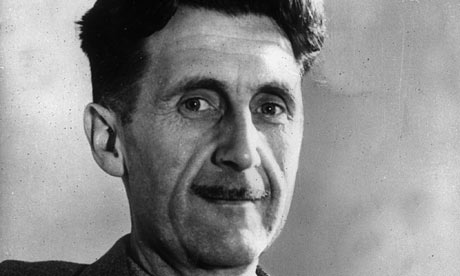
George Orwell – The King of Dystopia


Whenever I come across a news report about some new political scam or scandal which is pretty regular these days, I wonder if it is the ignorance of the masses that is allowing the political elite to indulge in such rampant corruption and malfeasance. Is India or even the world at large moving towards the dystopian society envisioned by George Orwell in his novel Nineteen Eighty Four?

In this novel, Orwell had described an Oligarchic dictatorship which borrows its stability from three basic tenets; one of these being - 'Ignorance is Strength'. Through pervasive government surveillance and incessant public mind control, the ruling ‘Party’ is able to subjugate the individual and manipulate humanity, hence strengthening its own domain.

It will be far-fetched to compare the present society with the society projected by Orwell; however the way things are going, the Orwellian conception remains still relevant and is a prism to the ill-fated consequences of a society that lacks democracy and free will.

Born in India as Eric Arthur Blair to a civil servant father in 1903, Orwell found the inspiration for his writings from his own life experiences. These included an early childhood in London, education in a missionary school, policing in Burma, his bohemian lifestyle in Paris, seeing the hardships of economically depressed North England, the participation in the Spanish Civil War and many other experiences which gradually developed in him a “natural hatred towards authority”.

He mentions in his essay Why I Write that “Every line of serious work that I have written since 1936 has been written, directly or indirectly, against totalitarianism and for democratic socialism, as I understand it,” evidently triggered by the Spanish Civil War and the increasing influence of Nazism and Fascism.

However, even his debut novel, The Burmese Days which got published in 1934, talks of the travails of a British subject in Burma disillusioned by imperialism and white domination.

It was his political satire, Animal Farm published in 1945 that brought him into limelight and for the first time prosperity in a life, otherwise filled with hardships. In a compact piece of fiction, he targeted the Stalin brand of Communism and was well appreciated in the West. The story revolves around a farm where animals take over control under the leadership of pigs but the leader gradually corrupts the socialist ideals on which their revolution was based.

However, Orwell’s concept of free will was not in consonance with the philosophy of another contemporary author hailed by the West, Ayn Rand. Both are known for their belief in individualism; however, while Rand stands for libertarianism, essentially a capitalist model, Orwell stuck to democratic socialism, a model of the welfare state which can be compared to Gandhian and Nehruvian socialism.

Despite this, several critics, particularly from the Left, accused Orwell of exploiting the street-folk, calling him a wolf-in-sheep's-clothing upper class intellectual posing as a revolutionary. However, Orwell withstood these criticisms and remained true to his convictions till the end of his life.

In his seminal work, Nineteen Eighty Four, published just before his untimely demise in 1950 due to an artery burst in the lungs, he once again brought to the fore the struggle between totalitarianism and an individual’s yearning to break the shackles imposed by it. Like most of his other novels, it had an unhappy ending where the individual finally succumbs to the system.

For this reason, Nineteen Eighty Four is usually categorized as a novel portraying political pessimism. However, it will be wrong to term his writings as pessimistic because Orwell preferred to stick to his conceived dystopian structures in order to make his argument against them stronger. Moreover, to consider it Orwell’s forecast of the probable future will be naïve as the author clarified it in a post-publication statement.

Just like the instability portrayed in his writings, Orwell had a rather unstable life. Growing up in the absence of his father, lack of resources in the family, a bitter school life, initial struggle to get his due as a writer, contracting tuberculosis and the subsequent deteriorating health and an unhappy married life, marked the forty seven years of his life.

However, his life did a great service to the literary tradition of that era and continues to inspire even today. According to Orwell, there are four great motives for writing; sheer egoism, aesthetic enthusiasm, historical impulse and political purpose. He was honest enough to mention the first motive though his way of writing and prose was by no means elitist. However, the other dimension of egoism is to be remembered for our work. Orwell’s legacy can be gauged from the simple fact that ‘Orwellian’ is now a byword for any oppressive or manipulative social phenomenon opposed to a free society.

As far as the last two motives go, his later works that in addition to his novels include a number of essays, literary reviews, linguistic articles, anti-war propaganda and other journalistic endeavours in BBC, the Tribune, the Observer and other journals ensured that they served the political purpose and facilitated the historical impulse.

In fact, many of his observations hold a lot of historical significance as they portray how some of the societal structures haven’t changed much in all these years. For example, in his autobiographical essay, "Such, Such Were the Joys" published after his death in 1952, Orwell describes the education he received as "a preparation for a sort of confidence trick," geared entirely towards maximizing his future performance in the admissions exams to leading English public schools such as Eton and Harrow, without any concern for actual knowledge or understanding. The education reforms in India today are also addressing similar problems in our system of education.

As for the final remaining motive, only the man of his genius could make a twelve line poem Romance written during his stay in Burma and based on the negotiations of a foreigner with a local prostitute, seem so aesthetic. Sample it for yourself.

When I was young and had no sense
In far-off Mandalay
I lost my heart to a Burmese girl
As lovely as the day.

Her skin was gold, her hair was jet,
Her teeth were ivory;
I said ‘For twenty silver pieces,
Maiden, sleep with me.’

She looked at me, so pure, so sad,
The loveliest thing alive,
And in her lisping, virgin voice,
Stood out for twenty-five.

Image Courtesy: